5 Minutes to Understand: Institutional Trust vs. Algorithmic Trust — A Guide to Traditional and On-Chain Fund Management

Updated: Jun 1
When I talk to new investors entering the digital asset space, the first question is usually: "What should I buy?" But the conversation should start with: "How do you want to manage your risk?"
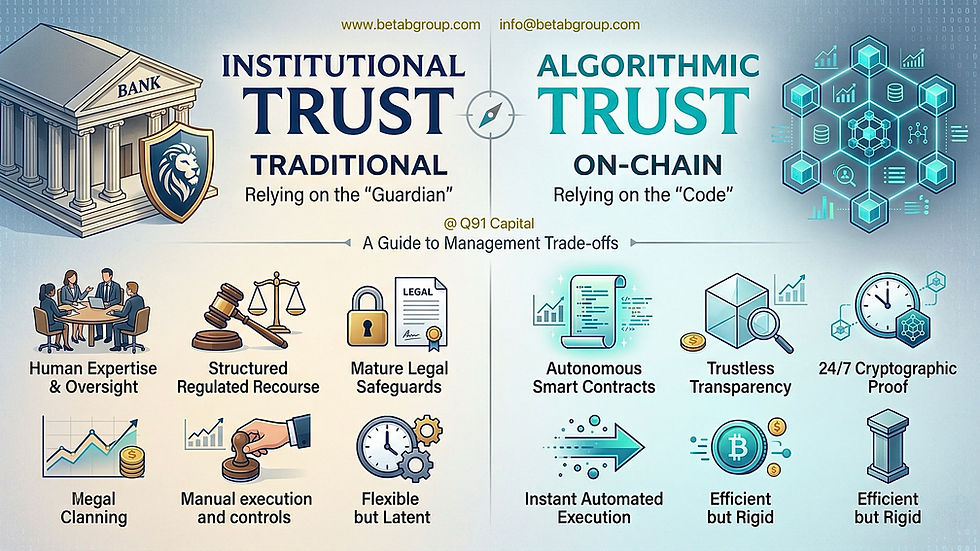
In the world of Web3, we are standing between two distinct architectures of trust. One relies on Institutional Trust (Traditional), and the other on Algorithmic Trust (On-Chain). Neither is a "perfect" solution; they are simply two different ways of securing and growing wealth. Here is my neutral analysis of how to view them.
Understanding Institutional Trust: Relying on the "Guardian"
Think of this as the "Human-led" approach. Your assets are held in secure environments, but the "keys" and the strategic decisions are managed by professionals or centralized platforms.
The Logic: You trust the reputation of the firm, the expertise of the manager, and the legal framework of the country.
The Upside: Human Flexibility. If you lose your password or a market flash-crash occurs, there is a person you can call. You have legal recourse—the law is your safety net.
The Reality Check: You are exposed to "Moral Hazard." Even the best systems are run by humans who can act slowly, make mistakes, or—in rare cases—act dishonestly.
Real-world Lesson (The FTX Collapse): FTX was the ultimate "Institutional" failure. Investors trusted a charismatic leader and a centralized entity. The failure wasn't in the blockchain technology itself, but in human greed and a total lack of transparency. When the "Guardian" failed, billions disappeared because users couldn't see the reality behind the marketing.
Exploring Algorithmic Trust: Relying on the "Code"
This is the "Code-led" approach. Here, you remove the middleman. You put your funds into a Smart Contract—essentially a digital, automated vending machine for finance.
The Logic: You trust mathematics and open-source protocols. The rules are written in code and executed automatically by the blockchain.
The Upside: Absolute Transparency. The system never sleeps. It rebalances and trades 24/7 with zero human bias. It offers high capital efficiency because the "code" moves money instantly without waiting for a manager's signature or business hours.
The Reality Check: Code is rigid. It doesn't have a "reset" button. If the smart contract has a logic flaw or a "bug," a hacker can exploit it in seconds.
Real-world Lesson (The Ronin Network Hack): In 2022, a bridge used by the game Axie Infinity was hacked for over $600M. This wasn't caused by a dishonest manager; it was a technical vulnerability in the code’s validator system. In this world, once a hacker finds a "door" left open by the code, the funds are gone instantly, and there is no "undo" button.
Comparison at a Glance
Feature | Institutional Trust (Traditional) | Algorithmic Trust (On-Chain) |
Foundation | People, Institutions & Regulation | Mathematics, Code & Protocols |
Safety Net | Legal Recourse & Insurance | Cryptography & Transparency |
Execution | Flexible but subject to human delay | Instant but subject to code rigidity |
Core Risk | Human Greed (e.g., FTX) | Technical Exploits (e.g., Hacks) |
Final Thoughts: Education is Your Real Security
There is no single “better” approach—only the one that aligns with your individual strategy and risk tolerance. Some investors value the structure and oversight of regulated institutions, while others are drawn to the efficiency and openness of on-chain systems.
Ultimately, the greatest risk in Web3 is not the technology itself, but the lack of understanding around it.
At Q91 Capital, we are a digital asset investment firm focused on the evolving crypto ecosystem. We also contribute to the industry through blockchain and digital asset education. Our focus is on supporting individuals in building a foundational understanding of how this ecosystem operates—from key security principles to the broader mechanics of decentralized systems.
Rather than providing investment advice, we aim to equip participants with the knowledge and perspective needed to navigate Web3 more confidently and responsibly. In a world where you are your own bank, education becomes your first and most important layer of security.
Navigating Your Path in Web3
As you explore the world of digital assets, consider what approach resonates with you. Do you prefer the security of institutional trust, or are you excited by the transparency of algorithmic trust? Each path has its own set of advantages and challenges.
Engaging with the community can also provide insights. Attend webinars, join forums, and connect with others who are on similar journeys. This shared knowledge can enhance your understanding and help you make informed decisions.
The Importance of Continuous Learning
The landscape of digital assets is constantly evolving. New technologies and regulations emerge regularly. Staying informed is crucial.
Consider subscribing to reputable newsletters, following thought leaders on social media, and participating in online courses. The more you learn, the better equipped you'll be to navigate this complex space.
Conclusion: Your Journey Awaits
In conclusion, whether you lean towards institutional or algorithmic trust, remember that your journey in Web3 is just beginning. Embrace the learning process and don’t hesitate to seek help when needed.
We’re here to power your Web3 and AI startup. Need help getting started or growing fast? We offer a full suite of services, all in one place. Think global marketing, financial services, and even operational outsourcing. We also cover legal compliance and business strategy consulting. What challenges are you facing? We equip you with essential supports, truly. Let's make sure you're ready now!
About this Article
Insights from Mariya Ebirayim | Powered by Beta.B Group
Mariya Ebirayim is the Beta.B Group and a seasoned Web3 investor with a global perspective. A fintech pioneer since 2013 and a Web3 mainstay since 2016, she has established a formidable track record as a strategic advisor and Limited Partner at Q91 Capital.
The core analysis in this article stems from Mariya’s extensive experience in the global expansion of high-profile ventures, including the Telegram Open Network (TON), where she facilitated Japan market entry, go-to-market strategies, and public offering initiatives.
Her thought leadership is recognized internationally, with features in the Japanese journal Monthly Crypto Asset and the strategic guide 40 Communication Tactics for International Success by Dr. Suzuki of the University of Tokyo. Beyond her professional practice, Mariya has been invited to deliver keynote lectures on innovation at prestigious institutions, including Waseda University and Sophia University in Japan.


Comments